

Expromet is building end-to-end capability around quality, control and supply chain reliability.
Supply chain resilience is a core operational priority in metal component manufacturing. Across aerospace, defence, marine, medical, energy and transportation sectors, OEMs and Tier 1 manufacturers are under increasing pressure to reduce supplier complexity, improve delivery performance and maintain tighter control over quality throughout the manufacturing process. Make UK notes that manufacturers are increasingly reassessing supplier relationships and supply chain resilience as operational priorities.
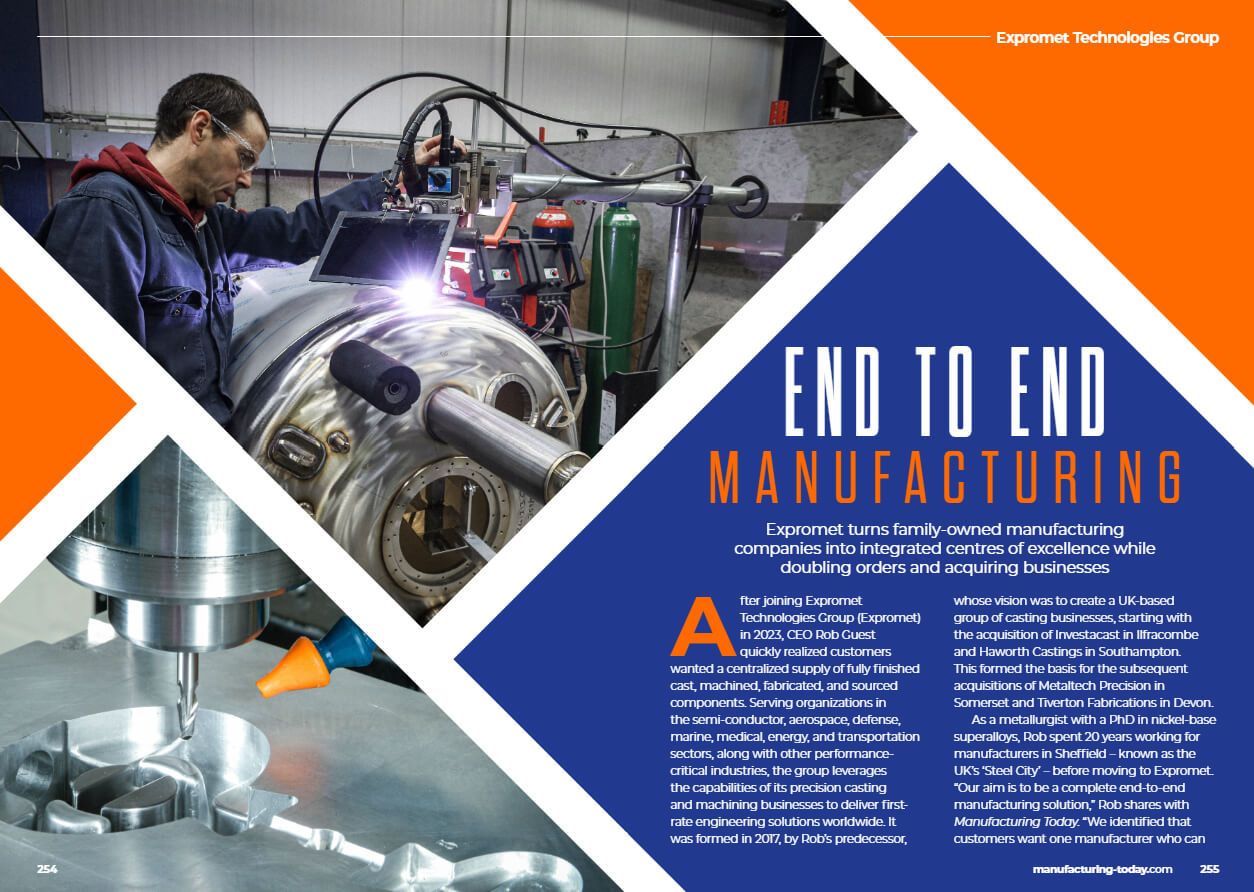
Expromet’s solution is to centralise the supply of fully finished cast, machined, fabricated and sourced components through a single, capable and technically integrated manufacturing group. As Expromet Technologies Group CEO Rob Guest explains in an article published in May’s Manufacturing Today,
“Customers want one manufacturer who can supply a turnkey solution across multiple manufacturing processes and reliably deliver high-quality, finished components. Expromet Technologies Group is one of the few companies that can offer this.”
Building capability around customer demand
This year, Expromet Group acquired of Tiverton Fabrications, extending the range of vertically integrated metal manufacturing processes available to customers.
Tiverton specialises in high-end fabrication, producing complex components such as cryogenic vessels and specialist vacuum chambers for sectors demanding exceptional engineering precision. The acquisition strengthens Expromet’s manufacturing capabilities for industries where performance-critical components are essential, including aerospace and defence, energy and marine, automotive and rail, medical and scientific equipment, industrial automation.
“Expromet’s strategy is to create centres of excellence for each of our specialised capabilities across the group,” notes Rob. “Tiverton aligns with this strategy and will become the centre of excellence for fabricated solutions.”
Reducing complexity in manufacturing supply chains
Complex components may pass through multiple specialist suppliers before final assembly and delivery: for example, a cast component may require machining, fabrication, surface finishing, inspection and assembly support, involving several subcontractors operating independently.
Every handover introduces additional lead time, communication risk and quality variation. For OEMs and Tier 1 manufacturers operating in performance-critical sectors, this creates unnecessary exposure. Expromet’s long-term strategy is to reduce that complexity by bringing complementary capabilities together within one manufacturing group, effectively offering customers a one-stop shop.
Fabrication
Fabrication is the next process for many of the of the cast and machined components manufactured by Expromet Group companies Haworth Castings, Investacast and Metaltech Precision. With the acquisition of Tiverton Fabrications, Expromet now offers expert fabrication capability. By improving control of the supply chain through this expansion, Expromet Group helps to reduce risk and improve efficiency for its customers.
Surface finishing and painting
Many products manufactured by Expromet companies are dispatched for surface treatment such as anodising, painting, or shot blasting, before they reach the customer. Expromet plans further expansion to take greater control of this part of the supply chain, too, says Rob.
“Our aim is to offer a fully integrated and reliable solution. Customers can access multiple manufacturing disciplines through one supply partner, maintaining technical oversight, quality control and delivery accountability across the process.”
Investment in automation and lights-out manufacturing
As part of Expromet’s ongoing commitment to delivering the best possible service to customers across demanding industries, the Group is investing significantly in state-of-the-art automated machining capability at Metaltech Precision.
An extensive array of over 60 machining centres is now supplemented with automation systems that enable lights-out manufacturing. In practical terms, key machines can now run unattended through the night, over weekends and beyond standard working hours without compromising precision or quality.
This builds on existing automated gantry multi-tasking capability at the Somerset facility, and reflects a strategy to develop automated capability, ensuring that customers benefit from the faster turnaround and scheduling flexibility offered by lights-out machining.
Maintaining standards while building a robust and sustainable team
Expromet’s growth is centred on maintaining high operational standards as capability expands.
This includes investment in equipment, structured training programmes, apprenticeships and leadership development across the Group. Partnerships with organisations such as Yeovil College support long-term workforce development, while mentoring programmes are helping develop future technical and operational leaders internally. The focus is on building sustainable capability rather than short-term expansion.
This matters particularly in sectors such as aerospace, defence and energy, where supplier reliability and engineering competence are critical to long-term customer relationships. Rob is confident that customers benefit as much as his team does from the trust that builds through thorough training and support.
“Everybody in my executive team mentors at least one other employee. We offer leadership courses and are committed to growing the next generation of managers rather than relying on external recruitment. From apprentices to leaders, we ensure that our whole team understands what customers need, the critical standards they must meet, and how to provide a partnership that truly supports our customers.”
A long-term ambition built around reliability
Expromet’s vision has evolved into becoming a world-class provider of vertically integrated metal manufacturing solutions. The group now reports a turnover of £35 million per year, with an order book that has grown from £5.5 million to £12.5 million in just 18 months.
The Group continues to strengthen complementary manufacturing capabilities that improve operational control, supply chain reliability and technical depth, allowing it to become a trusted manufacturing partner across critical industries.
In addition to these UK manufacturing capabilities, Expromet’s team of engineers can Design for Manufacture cast, forged and machined product in the UK and then source those products from their established supply chains in low-cost countries.
As global supply chains continue to evolve, the ability to provide such reliable, technically capable and increasingly integrated manufacturing support is becoming a significant competitive advantage.
For Rob, the path to success is clear:
“Our goal is to be a trusted partner to key OEMs and Tier 1s, while maintaining uncompromising standards as we grow.”
Discuss your manufacturing requirements
If you are looking to reduce supplier complexity, improve delivery reliability or source fully finished metal components, speak to Expromet about your requirements.
Our group companies provide specialist capability across casting, machining, fabrication and wider manufacturing support.
FAQs
1. What is an integrated manufacturing partner?
An integrated manufacturing partner provides multiple manufacturing processes within one coordinated supply structure. This may include casting, machining, fabrication, finishing and assembly support, reducing the need for OEMs and Tier 1s to manage multiple suppliers.
2. Why are OEMs and Tier 1s moving towards integrated manufacturing partners?
OEMs and Tier 1s are simplifying supply chains to improve quality control, delivery reliability and accountability. Integrated manufacturing partners help reduce supplier complexity and improve coordination across multiple production stages.
3. What are the benefits of vertically integrated manufacturing?
Vertically integrated manufacturing improves supply chain control by reducing production handovers between suppliers. Benefits can include shorter lead times, improved consistency, clearer accountability and better communication across manufacturing stages.
4. How does integrated manufacturing improve supply chain reliability?
Integrated manufacturing reduces the number of separate suppliers involved in production. This helps minimise delays, communication issues and quality variation while improving scheduling and technical oversight.
5. What manufacturing processes are commonly integrated together?
Integrated manufacturing groups commonly combine casting, CNC machining, fabrication, finishing, inspection and assembly support within one coordinated manufacturing structure.
6. Why is fabrication important in end-to-end manufacturing?
Fabrication is often required after casting or machining, particularly for assemblies and engineered systems. Integrating fabrication capability helps reduce lead times and improves coordination between manufacturing stages.
7. What is lights-out manufacturing?
Lights-out manufacturing uses automated production systems that can continue operating outside normal working hours with minimal intervention. It is commonly used in advanced CNC machining environments to improve efficiency and throughput.
8. Does automation reduce the need for skilled machinists?
No. Automated manufacturing still depends on skilled machinists, programmers and engineers to develop machining strategies, optimise processes and maintain quality standards.
9. Which industries benefit most from integrated manufacturing?
Integrated manufacturing is widely used in aerospace, defence, energy, marine, medical and advanced engineering sectors where quality, traceability and delivery reliability are critical.
10. What should OEMs look for in an integrated manufacturing partner?
OEMs typically look for technical capability, quality assurance, industry experience, reliable delivery performance and the ability to manage multiple manufacturing processes within one coordinated supply structure.