

How Expromet Technologies Group selects manufacturing processes for components across the cabin interior
Written by: Keir Lane, Technical and Quality Director
Date: 20 May, 2026
Overview: Aircraft interior manufacturers require metal components that are strong, lightweight, dimensionally precise and certifiable to aerospace standards. Expromet Technologies Group supplies cast, forged and machined components across the cabin interior – with the technical expertise to recommend the optimal manufacturing process for each individual part.
The aircraft cabin is one of the most engineered environments in mass production. Every metal component within it, from the legs that anchor a seat to the floor, to the latches that secure an overhead locker and the structural brackets within a galley unit, must meet demanding load requirements, withstand years of cyclic use and contribute as little weight as possible to the overall aircraft.
For interior manufacturers and their supply chains, the manufacturing process selected for each metal component directly determines cost, lead time, performance and certification risk.
Expromet Technologies Group works with OEMs and Tier 1s to supply precision investment castings, pressure die castings and closed die forgings for aircraft interior applications. Through its group companies, Expromet has the capability and the track record to advise on and deliver the right manufacturing solution for each component.
The engineering challenge: strength, weight and repeatability at scale
Aircraft interior components sit at the intersection of several competing demands. They must be structurally sound: seat structures, overhead stowage systems and galley components are all subject to dynamic load and certification requirements. They must be lightweight, because every gram added across hundreds of seats, stowage bins and galley units has a measurable impact on fuel consumption and payload. And they must be produced to consistent tolerances, because interchangeability and fit-up during assembly leave little room for dimensional variation.
These demands do not point uniformly towards a single manufacturing process. A component that requires high surface definition and a complex three-dimensional form may be best served by investment casting. One that carries significant tensile or fatigue loads may benefit from forging. One that requires tight tolerances and a fine finish may need machining – but the question is whether it needs to be machined from solid, or whether a near-net-shape forging or casting can reduce material waste and machining time substantially.
Expromet adds value by getting that process selection right from the outset. Aircraft seating is one of the most demanding applications within the cabin interior, and a useful illustration of how that process selection works in practice.
Economy class seating: matching process to component
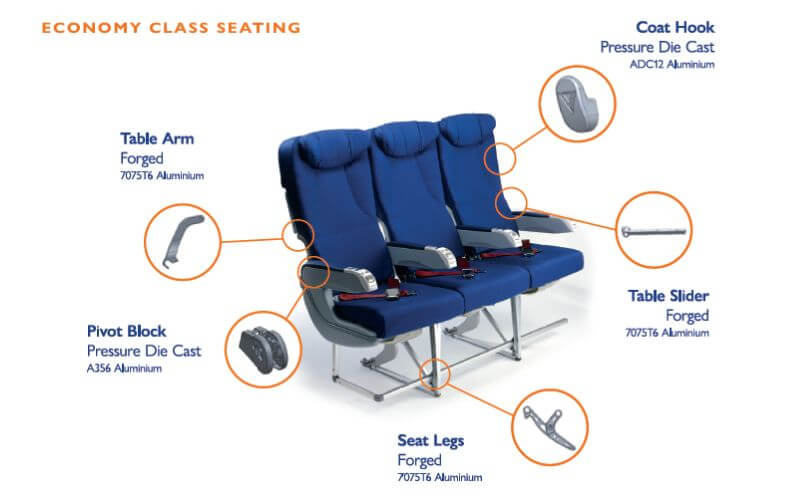
Economy class aircraft seats are produced in very high volumes, and the cost pressure on each component is significant. The engineering challenge is to achieve the required structural performance at the lowest possible cost per part, without compromising on certification compliance or dimensional consistency.
Pivot blocks are pressure die cast in A356 aluminium. Pressure die casting is well suited to this application – it achieves the tight tolerances and excellent surface finish that pivot block geometry demands, with the high repeatability that high-volume seat production requires. A356 aluminium offers a good balance of strength, castability and corrosion resistance.
Coat hooks are produced by pressure die casting in ADC12 aluminium. The geometry is compact and the functional requirement straightforward: a strong, well-finished part produced consistently at volume.
Tray table arms are also pressure die cast, with aluminium alloys selected to suit the structural and dimensional requirements of the tray table mechanism.
Table sliders and seat legs, by contrast, are closed die forged in 7075T6 aluminium – one of the highest-strength aluminium alloys in common aerospace use.
Why forging rather than machining from solid?
When aluminium is forged, the grain structure flows continuously through the shape of the component. Machining from solid cuts across that grain, reducing fatigue resistance. For seat legs and table sliders – components that absorb significant cyclic loading across the service life of the seat – the difference in structural performance matters.
There is also a cost argument. A forging arrives close to its final shape, reducing material waste and machining time. For components produced at scale, the savings of forging over machining from solid can be substantial.
Nickel-base superalloys
Nickel-base superalloys are increasingly used across performance critical industries due to their exceptional strength, corrosion resistance, and high-temperature performance. While these materials can be challenging to manufacture using conventional methods, investment casting enables the production of complex near-net-shape components with reduced machining and finishing requirements. Investacast has extensive expertise in the investment casting of nickel-base superalloys, applying rigorous process control to deliver high-integrity components for demanding aerospace environments.
Business class seating: higher complexity, same process discipline
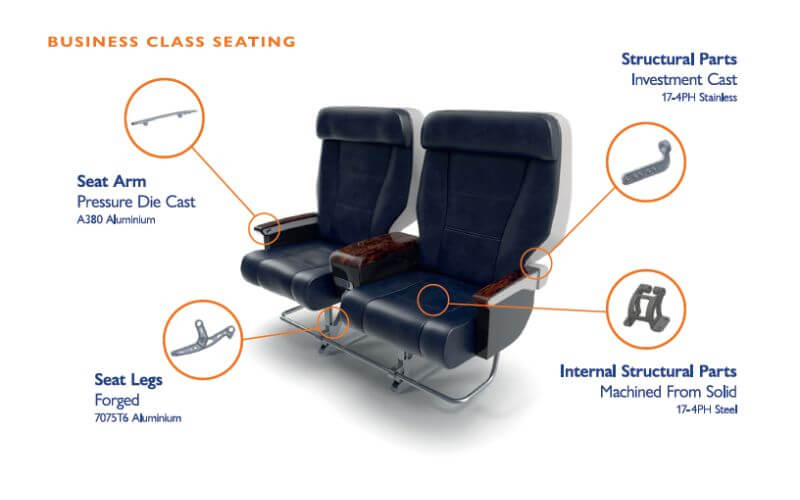
Business class seats differ significantly from economy seating in both structure and manufacturing complexity. Typically produced in lower volumes with greater variation, they present a unique set of engineering challenges. Structural assemblies are more intricate, while load cases are considerably more varied, particularly in flat-bed configurations where seat frame structures are subjected to unconventional mechanical demands. As a result, components often feature complex geometries and are frequently machined from solid metal to achieve the required strength, precision, and performance. Certain structural components within the seat assembly may also be produced through forging or investment casting processes.
Internal structural parts (the load-bearing skeleton of the seat) are investment cast in 17-4PH stainless steel through Investacast’s work in aircraft interiors. Investment casting in 17-4PH is a technically demanding process. The alloy achieves a mechanical strength exceeding 1,100 MPa with excellent ductility, and investment casting allows thin walls down to 1.5mm locally: geometry that would be difficult or impossible to achieve by other means. The result is a structural component that is both strong and lightweight.
Material selection is central to achieving these results. The choice between alloys such as 17-4PH stainless steel, 7075T6 aluminium and A356 aluminium is governed by the mechanical requirements, geometry and production volume of each component – a topic covered in detail in Investacast’s guide to material selection for investment casting.
It is worth noting that some manufacturers currently machine internal structural parts from 7 series aluminium or solid 17-4PH steel, a route that delivers the required mechanical properties but at a higher material and machining cost. Expromet has a strong track record of working with customers to evaluate conversion from machined to cast or forged components, maintaining structural performance while reducing cost and lead time.
Beyond seating: the same disciplines applied across the cabin
Aircraft seating is the most complex and volume-intensive application within the cabin interior, which is why it makes a useful illustration of Expromet’s process selection approach. But the same manufacturing logic applies wherever precision metal components are required within the aircraft cabin.
In each case, the starting point is the component and its intended use. Identifying the specific requirements of each part of an aircraft interior helps determine which manufacturing process is best suited to production, and where the trade-offs between casting, forging and machining arise.
The case for a multi-process group supplier
Most precision metal component manufacturers specialise in one process. The limitation of that model is that the advice you receive is shaped by the capability on offer – you are unlikely to be told that a different process would serve your application better.
Expromet has expert casting, forging and machining capability across its Group companies, removing that constraint. The Group can advise on Design for Manufacture, starting with the component and its requirements (geometry, load case, volume, material, tolerance, finish) and recommend the best process following that analysis, not the other way around.
This Group model also simplifies supply chain management for OEMs and Tier 1 contractors managing separate supplier relationships for cast, forged and machined parts. Expromet provides end-to-end management of the supply chain, including trusted overseas manufacturing partners where volume or specific process capabilities make that the right solution. UK-based programme management, with an R&D centre that includes casting simulation software and rapid prototyping capability: true supply chain partnership.
Expromet group companies hold AS9100, ISO 9001 and JOSCAR registration across their operations: the quality and supply chain credentials that aerospace and defence prime contractors and Tier 1 suppliers require.
For supply chain managers working under pressure to consolidate supply, manage certification risk and maintain cost competitiveness, that combination of technical breadth, quality and supply chain control is a meaningful differentiator.
Work with a supplier that starts with the component, not the process
Whether you are sourcing components for a new interior programme, evaluating conversion from machined to cast or forged parts, or looking to consolidate your cabin interior supply chain under fewer, more capable partners, Expromet has the technical expertise and manufacturing breadth to help.
Contact the Expromet team to discuss your aircraft interior component requirements
FAQs
1. What metals are used in aircraft interior components?
The most common materials are high-strength aluminium alloys – 7075T6 for forged structural components and A356, A380 and ADC12 for pressure die cast parts – and 17-4PH stainless steel for investment cast structural components. Material selection is governed by the load case, geometry and manufacturing process required for each individual component.
2. Why is forging preferred over machining from solid for structural cabin components?
Closed die forging preserves the continuous grain flow of the metal through the shape of the component, producing superior fatigue resistance compared to machining from solid, which cuts across the grain structure. Forging also produces a near-net-shape part, reducing material waste and machining time at scale.
3. What is investment casting and why is it used in aircraft interiors?
Investment casting produces complex, thin-walled components to high dimensional accuracy in high-performance alloys – making it well suited to structural parts where geometry is too intricate for forging and mechanical requirements are too demanding for pressure die casting. Expromet’s Investacast division produces investment castings in 17-4PH stainless steel with wall thicknesses down to 1.5mm and mechanical strength exceeding 1,100 MPa.
4. Can Expromet supply components for applications beyond aircraft seating?
Yes. Expromet’s casting, forging and machining capabilities apply across the wider cabin environment – including overhead stowage systems, galley structures, cabin monuments and interior brackets. The same process selection approach applies regardless of application.
5. Where are Expromet’s manufacturing facilities?
Expromet Technologies Group is UK-based, with an R&D centre offering casting simulation software and rapid prototyping capability. The group also manages a global supply chain through trusted overseas manufacturing partners, with end-to-end programme management from UK operations.